The Evolution of Sales Funnels in the Digital Economy: From Linear Pipelines to Human-Centered Loops


The Evolution of Sales Funnels in the Digital Economy: From Linear Pipelines to Human-Centered Loops
Introduction
The way we think about sales funnels has changed more in the last decade than in the previous fifty years combined. I remember when funnels were neat, almost smugly simple: awareness, interest, decision, action. Those static columns on a whiteboard felt tidy, but they lied—customers were already messy, and the web only amplified that chaos.

Today, a funnel is less a narrow pipe and more a living ecosystem—part marketing, part product experience, part community. The shift matters because attention is scarce and trust is everything. If you care about growth that lasts, you’ll want to build systems that respect people’s time and preferences while reflecting a transparent company culture that customers can sense and reward.
This article walks through that transformation with practical examples, my own observations from working with teams, and a few actionable tips you can use right away—whether you’re asking for a “guia evolution sales” or just want an honest evolution sales tutorial.
Desenvolvimento Principal
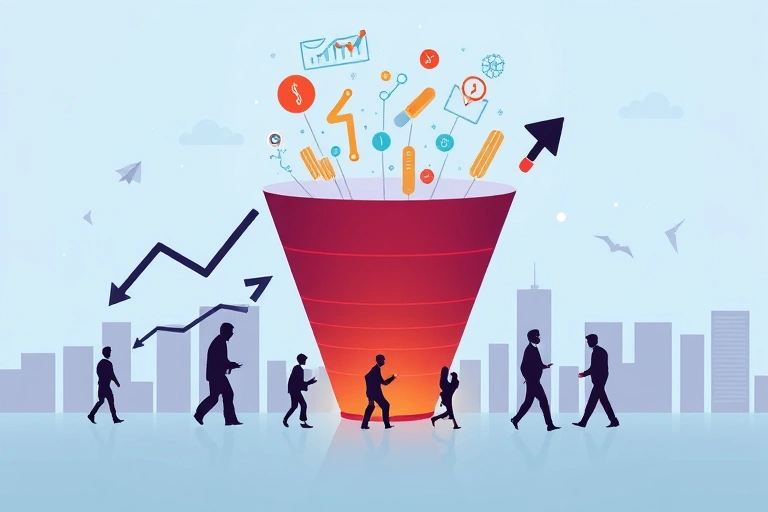
Sales funnels used to be linear because media and measurement were linear. Ads pushed messages, reports tallied clicks, and a lead moved predictably from left to right. But the digital economy introduced layers of touchpoints: search, reviews, influencers, community threads, product-led onboarding, and service interactions. That complexity forced funnel thinking to become dynamic.
So what changed, practically? First, people now discover brands via peers as much as via advertising. Second, product experiences doubled as marketing—your first-run product tour can convert like a salesperson. Third, data became real-time and actionable. And fourth, buyers expect honesty; they sniff out smoke and reward companies that are open about pricing, mistakes, and processes.
- From awareness-first to experience-first: product demos, free tiers, and trial experiences became primary conversion channels.
- From linear paths to loops: activation, retention, advocacy form repeating cycles rather than one-way funnels.
- From opaque operations to transparency: a transparent company culture affects conversions because trust reduces friction.
In short, the funnel evolved into a series of interconnected journeys. That means your job isn’t solely to push leads into a pipeline—it’s to design a delightful, coherent journey that keeps returning customers in your orbit. Sound dramatic? Maybe. But it reflects how attention and loyalty are earned today.
Análise e Benefícios
Let’s break down why this evolution isn’t just trendy jargon. When you replace a rigid funnel with a looped, human-centered approach, several benefits emerge. Retention improves because you’re optimizing for ongoing value rather than a one-time conversion. Lifetime value increases because delighted customers refer and repurchase. Acquisition costs fall when community and product do some of the heavy lifting.
But there’s a subtle gain that often gets missed: alignment. When marketing, product, and customer success share funnel metrics and incentives, decisions become smarter. I’ve sat in too many meetings where teams argued over vanity metrics while the customer experience suffered. A culture that emphasizes transparency—yes, transparent company culture again—helps teams see what truly matters and reduces internal friction.
Another upside is agility. With better tracking and faster feedback loops, you can test hypotheses quickly and learn. Want to know whether changing onboarding copy increases retention? Test it, measure it, iterate. It’s messy, yes, but that mess is how companies find meaningful growth, not by following a stale checklist.
Implementação Prática
Alright, enough framing—let’s get practical. If you’re wondering como usar evolution sales or need a step-by-step start, here’s a compact playbook I’ve used with startups and bigger teams alike. These steps emphasize rapid experimentation, alignment, and a little pragmatic humility.
- Map real customer journeys, not idealized funnels. Interview customers, watch session recordings, and document pain points.
- Identify high-leverage moments—sign-up, first success, renewal conversations—and instrument them with data.
- Design small experiments: tweak copy, add a micro-onboarding task, or test a community nudge. Run for short windows and measure.
- Share results across teams in a single dashboard and decide what to scale based on both quantitative and qualitative signals.
- Iterate constantly, and make a habit of closing the loop with customers—ask, listen, act, then tell them what you changed.
And yes, if you’re looking for a more guided approach, a short guia evolution sales or an evolution sales tutorial built around these steps is a great place to start. Keep the tutorials practical—templates, scripts, and checklists beat theory when you’re in the weeds.
From my experience, teams who adopt this approach don’t just see metrics improve—they behave differently. Meetings are shorter because everyone trusts the dashboards. Product decisions are quicker because the evidence is obvious. Hiring becomes easier because candidates can see the way the company works: how transparent decisions are, how failures are handled, how wins are celebrated.
Perguntas Frequentes
What exactly is “evolution sales” in the digital economy?
Evolution sales is less a single tool and more a mindset: shifting from a linear, acquisition-first funnel to a cyclical, value-first system where product, marketing, and support collaborate to create recurring value. It recognizes that modern buyers interact with many touchpoints and that the best growth comes from retention and advocacy as much as new leads.
How do I start implementing evolution sales in a small team?
Begin small. Map one real customer journey, pick one high-leverage metric (like first-week retention), and run an experiment focused on that metric. Use qualitative feedback to interpret results. If you want a quicker start, follow a compact guia evolution sales that includes templates for interviews and experiment design.
Is there a simple evolution sales tutorial I can follow?
Yes—an effective tutorial focuses on three parts: understand (customer research), improve (rapid experiments), and scale (operationalize what works). A practical tutorial will give you scripts for user interviews, a checklist for onboarding optimization, and a simple dashboard layout so you can see impact in days, not months.
Can transparency really affect conversion rates?
Absolutely. Customers trust companies that are upfront about pricing, limitations, and data practices. A transparent company culture shows up externally: published success metrics, honest case studies, or even public product roadmaps reduce buyer hesitation. It’s not a magic bullet, but it lowers friction and builds loyalty over time.
How do I measure success without getting lost in vanity metrics?
Focus on a handful of meaningful indicators: new user activation, 7–30 day retention, expansion revenue, and net promoter or referral activity. Combine those numbers with user interviews and churn reasons. If an experiment raises trial signups but lowers retention, that’s a hint something’s off—don’t celebrate that one metric in isolation.
What tools help automate the modern funnel without losing the human touch?
Use tools that balance automation with personalization: behavioral analytics platforms to trigger context-aware messages, product analytics for funnel instrumentation, and community platforms to foster advocacy. But never automate empathy—use automation to scale real, human-led interactions, not to replace them.
How should I train teams on this new approach?
Train with real examples and short sprints. Run a “hack week” where cross-functional teams own an experiment from ideation to measurement. Pair data sessions with customer interviews so people learn to read numbers and human stories together. Reinforce learning with a shared playbook or an internal evolution sales tutorial.
Conclusion
We started by treating funnels as tidy diagrams, and we end with messy, beautiful reality: customers whose journeys loop back on themselves, influence relations that matter far more than single clicks, and teams that win when they are honest and aligned. The evolution of sales funnels is, ultimately, a story about respect—respect for customers’ time and attention and respect for the internal clarity that comes from a transparent company culture.
If you’re serious about modernizing your sales approach, don’t chase every shiny tactic. Instead, map real journeys, experiment quickly, and make transparency a habit. And if you want a hands-on starting point, search for a compact guia evolution sales or an evolution sales tutorial that gives you scripts, metrics, and a rhythm you can repeat. Growth built that way tends to stick—and that’s the whole point.